 How-to
How to Build a Wine and Cheese Pairing Guide for Hosts
Last Updated: October 28, 2026
Quick Summary
Great wine and cheese pairing comes down to one rule: match intensity, then fix fat with acid. A delicate cheese needs a light wine, while a bold, salty cheese needs a wine with enough acid or sweetness to cut through it. Plan on about 3 ounces of cheese per person and roughly half a bottle of wine per drinking guest.
- Buy three to five cheeses, always in odd numbers for visual balance.
- One bottle pours about five 5-ounce glasses, so round up one bottle for every ten guests.
- Serve the lightest wines and mildest cheeses first, then build toward bolder flavors.
- For a structured tasting, pour 1 to 1.5 ounces per wine so guests can finish five courses.
- Take soft cheeses out of the fridge an hour before serving.
Table of Contents
- Start With the Pairing Rule That Decides Everything
- Your Wine and Cheese Pairing Chart for the Board
- How Much Wine and Cheese Per Person to Buy
- How to Host a Wine and Cheese Tasting Without Chaos
- The Wine and Cheese Tasting Order That Keeps Palates Fresh
- Dietary Needs, Budget, and Troubleshooting the Board
- Order Your Pairing Wines for Delivery Before the Party
- Frequently Asked Questions
Start With the Pairing Rule That Decides Everything
Great wine and cheese pairing comes down to one rule: match intensity, then fix fat with acid. A delicate cheese needs a light wine. A bold, salty cheese needs a wine with enough acid or sweetness to cut through it.
Most hosts get this backwards. They pick a wine they love, then grab whatever cheese looks good. The result is a plate where one item bulldozes the other.
Match Intensity, Then Balance Fat With Acidity
Wine and cheese pairing is the practice of matching a wine's weight and acidity to a cheese's texture and fat content so neither overwhelms the other. Weight is the first filter.
Acidity is the second filter. Cheese is fatty and often salty. Acid cleans the palate between bites. That is why a crisp white wine so often beats a big red.
- Delicate cheese, light wine
- Bold cheese, bold wine
- Creamy cheese, high-acid wine
Three Pairings That Work for Almost Any Crowd
If you only buy three bottles, buy these. They cover soft, hard, and salty without a single dud.
- Sauvignon Blanc with goat cheese. The classic starter. Herbal, tangy wine meets tangy, creamy cheese.
- Chardonnay with brie. A richer white for a soft, buttery cheese. Works every time.
- Cabernet Sauvignon with aged cheddar. A big red for a big, sharp, aged cheese.
Your Wine and Cheese Pairing Chart for the Board
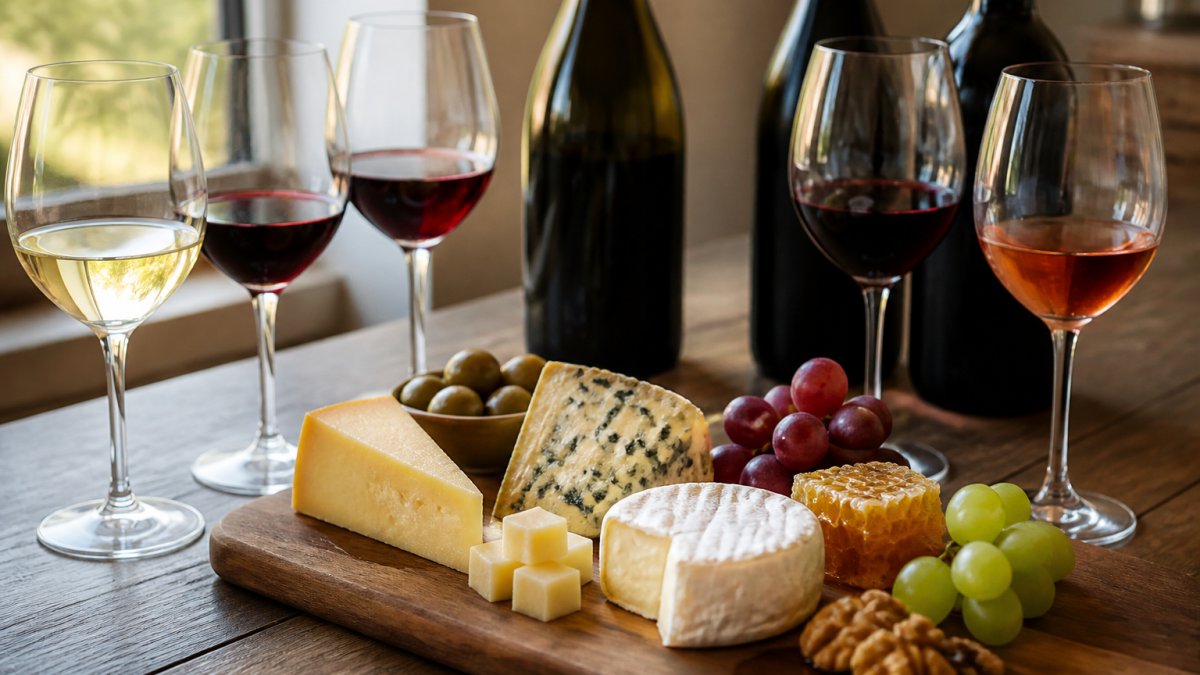
A wine and cheese pairing chart can help organize a shopping list. Build your board around three or four cheese styles, then pick one wine for each.
| Cheese Style | Example | Wine to Pour | Why It Works |
|---|---|---|---|
| Fresh and soft | Goat cheese, feta | Sauvignon Blanc | Acid matches tang |
| Soft and creamy | Brie, triple-crème | Chardonnay | Rich meets rich |
| Hard and aged | Cheddar, Gruyère, Comté | Cabernet Sauvignon | Bold meets bold |
| Salty and blue | Blue cheese, Roquefort | Port or Sauternes | Sweet cuts salt |
| Smoky | Smoked gouda | Dry rosé | Fruity, low tannin |
Notice the pattern. Fresh and soft cheeses lean white. Aged and hard cheeses can carry red. Salty and spicy cheeses want sweetness. Keep this chart on your phone at the store.
How Much Wine and Cheese Per Person to Buy
Plan on about 3 ounces of cheese per person for a two-hour gathering, and roughly half a bottle of wine per drinking guest. Those numbers keep a board generous without leaving you with a fridge full of leftovers.
Here is how that plays out in practice.
- Cheese: 3 to 4 ounces per person if cheese is the main food, 2 ounces if it is an appetizer
- Wine: half a bottle per guest over two hours, more if the party runs long
- Variety: three to five cheeses, always in odd numbers for visual balance
A Scalable Shopping List by Party Size
Most hosts underbuy wine and overbuy cheese. Use this table to size the whole spread at once, then adjust for how heavy the cheese course is.
| Guests | Cheese (main food) | Cheese (appetizer) | Wine bottles | Crackers/bread | Glasses to set out |
|---|---|---|---|---|---|
| 6 | 18-24 oz | 12 oz | 3-4 | 12 oz | 12 |
| 10 | 30-40 oz | 20 oz | 5-6 | 20 oz | 20 |
| 16 | 48-64 oz | 32 oz | 8-10 | 32 oz | 32 |
| 24 | 72-96 oz | 48 oz | 12-15 | 48 oz | 48 |
A few rules of thumb behind those numbers:
- One bottle pours about five 5-ounce glasses. Round up one bottle for every ten guests so you never run dry mid-toast.
- Set out two glasses per guest if you are pouring more than one wine. Guests reuse one glass for whites and one for reds, which cuts dishwashing and keeps pours clean.
- Buy cheese in whole pieces, not pre-crumbled. A wedge or block holds up on a board far longer than crumbles, and you can cut to the headcount.
A Budget Framework That Still Looks Generous
Set a per-guest number before you shop, then split it across three tiers so one splurge does not blow the whole board.
- Everyday bottles (about 60% of the wine budget): one crisp white and one versatile red that work with several cheeses.
- One splurge bottle (about 25%): a sparkling wine or a dessert wine that makes the board feel special.
- One wildcard (about 15%): a rosé or an off-dry white to cover guests who avoid tannin.
On the cheese side, spend the most on one aged or blue cheese, those carry the most flavor per ounce, and fill the rest of the board with fresher, lower-cost styles. A board built this way reads as generous without a single expensive item doing all the work.
Bottle Math for a Two-Hour Party
A standard bottle holds about five glasses. For ten guests over two hours, that is roughly five bottles total. Round up to six so you never run dry.
Watch out: overbuying cheese is the most common hosting mistake. Cheese does not improve with age once cut, so buy to the headcount and no more.
How to Host a Wine and Cheese Tasting Without Chaos
A wine and cheese tasting runs smoothly when you set up stations, label everything, and pour in a set order. The host's job is to remove decisions from the room, not add them.
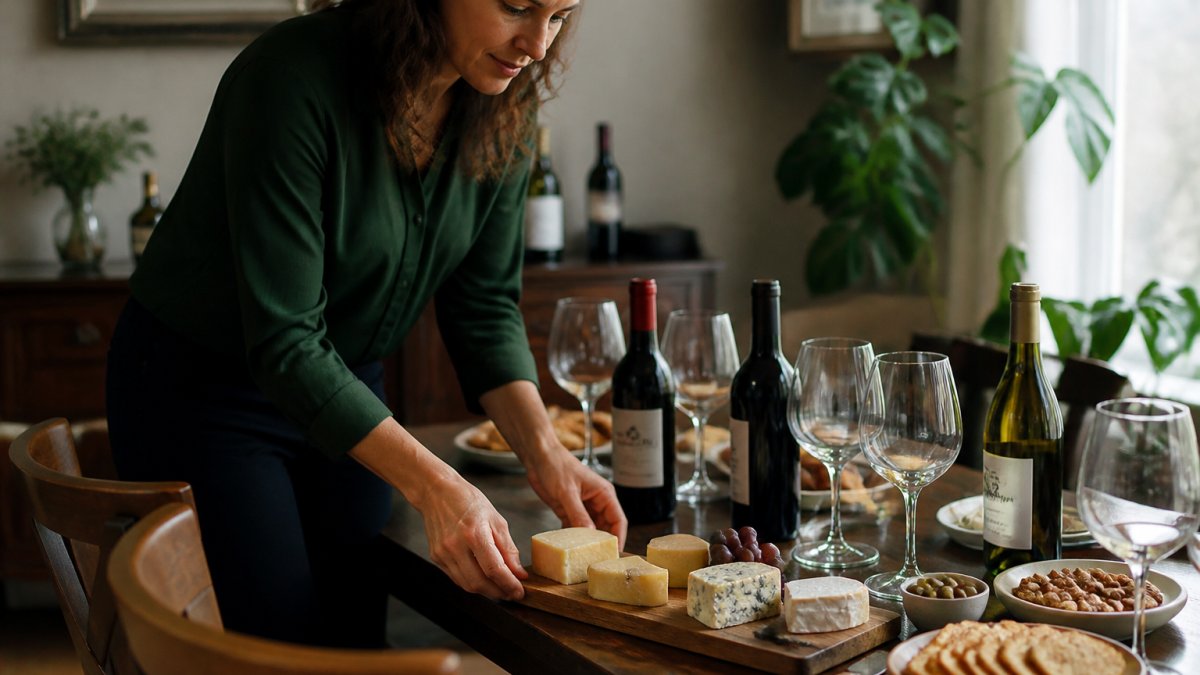
Follow these steps and the evening runs itself.
- Two days out: pick your cheeses and wines from the chart.
- The morning of: take soft cheeses out of the fridge an hour before serving.
- One hour before: set out boards, labels, glasses, and a water pitcher.
- At the door: hand guests a glass and point them to the first station.
- During: refill quietly, clear plates, and let guests pace themselves.
Label each cheese with its name and its wine. That one small step turns a party into a tasting.
The Wine and Cheese Tasting Order That Keeps Palates Fresh
Serve the lightest wines and mildest cheeses first, then build toward bolder flavors.
The wine and cheese tasting order is the part most hosts skip, and it is the part guests notice. Start with sparkling wine and fresh cheese.
- Course 1: sparkling wine with fresh goat cheese
- Course 2: Sauvignon Blanc with feta or a soft cheese
- Course 3: Pinot Noir with Gruyère
Sparkling wine is the most versatile pour on the table. It resets the palate between courses, which is why so many tasting guides open with it.
Why the Order Works
The sequence follows two rules that most guides state but never explain.
- Light before heavy. Delicate wines and mild cheeses lose their edge once a bold, salty cheese coats the palate. Going light to heavy means every course gets tasted on its own terms.
- Dry before sweet. Sweet wines make dry wines taste thin and acidic. Save the Port or Sauternes for last so the finish feels like a crescendo, not a letdown.
A third rule matters for reds: low tannin before high tannin. A big Cabernet early in the evening makes the Pinot Noir that follows taste watery. Pour the lighter red first and let the bold one close the red portion of the tasting.
Palate Cleansers and Pacing
Between courses, give guests something neutral to reset with. Plain water and a bite of bread do more than most hosts realize.
- Still water, not sparkling, between reds, carbonation can amplify tannin.
- A plain cracker or a slice of baguette between cheeses clears fat without adding flavor.
- A few minutes between courses lets guests talk and pace themselves. Rushing the sequence is what makes palates tired.
Adapting the Order for a Casual Board
Not every party needs five courses. If you are setting out one board and three bottles, arrange them left to right from lightest to boldest and label each with the cheese it suits best. Guests serve themselves in the same order a guided tasting would follow, without anyone having to run the sequence.
For a larger party, keep the structured order only for the first hour, then let guests mix. The early sequence sets the tone; after that, the board should feel relaxed, not managed.
Dietary Needs, Budget, and Troubleshooting the Board
A good board works for every guest, including the ones who do not drink or cannot eat dairy. Plan those options before the party, not during it.
Inclusive Alternatives That Still Taste Good
Not everyone at your table drinks wine or eats cheese. That is easy to handle with a little planning.
- No alcohol: sparkling water with citrus, or a good non-alcoholic sparkling wine
- No dairy: aged hard cheeses contain little lactose, and olive tapenade or cured meats fill the gap
- No pork: skip charcuterie and lean on nuts, fruit, and marinated vegetables
Ask guests about restrictions when you send the invite. A single question saves a lot of guesswork.
When a Pairing Falls Flat
Sometimes a pairing just does not work. Fix it without starting over.
- Wine tastes harsh: the cheese is too mild. Add a sharper, saltier cheese.
- Cheese tastes flat: the wine is too light. Pour something bolder.
- Everything tastes bitter: too much tannin. Switch to a lower-tannin red or a white.
On budget, set a per-guest number first, then buy one splurge bottle and fill the rest with solid everyday picks.
Order Your Pairing Wines for Delivery Before the Party
The best wine and cheese pairing guide for hosts ends where the party begins: with bottles at your door. Bel Pre Fine Wine delivers quality wine and beer straight to your home, so you can plan the board without a last-minute store run.
Our free loyalty rewards program celebrates our valued customers with every purchase.
Get started with Bel Pre Fine Wine and build a board your guests will remember.
Frequently Asked Questions
What wines pair best with cheese?
The safest rule is to match intensity: delicate cheeses with light wines, bold cheeses with fuller wines. Sauvignon Blanc with goat cheese, Chardonnay with Brie, and Cabernet Sauvignon with aged cheddar are reliable starting points. Sparkling wine works across a whole board because its acidity cuts through fat. If you build a wine and cheese pairing around three bottles, choose one crisp white, one light red, and one sparkling, then add a sweet wine only if blue cheese is on the table.
How much wine and cheese should you serve per person?
Plan on roughly 3 to 4 ounces of cheese per person across three to five varieties, and about half a bottle of wine per guest for a two-hour gathering. A 750 ml bottle pours five 5-ounce glasses, so ten guests drinking wine need about five bottles. Add one extra bottle as a buffer. If the party runs longer or includes a seated meal, increase the wine estimate. Buying slightly more cheese is safer than running short.
Should wine or cheese be tasted first?
Taste the wine first, then the cheese, then the wine again. The first sip sets a baseline, the cheese shows how the pairing changes, and the second sip reveals whether the wine holds up or turns harsh. This matters most with high-tannin reds, which can taste bitter against salty cheese. For a hosted tasting, pour a small taste of each wine, let guests try it alone, then add the cheese. Keep water and plain crackers nearby so palates reset between flights.
What should you serve with wine and cheese besides crackers?
Add contrast and texture: sliced apple or pear for creamy cheeses, honey for blue cheese, fig jam or quince paste for aged varieties, and Marcona almonds or olives for salt. Charcuterie such as prosciutto or salami rounds out a cheese board and gives guests who skip dairy something to eat. Keep bread plain and sliced so it does not compete with the wine. Set out small plates and napkins, and label each cheese so guests know what they are tasting.